Two invasive insects do most of the damage to yard and woodlot trees in Lancaster County: emerald ash borer, which kills ash trees, and spongy moth, which strips oaks and other trees of their leaves. This guide covers how to recognize each one, when a tree is worth treating, what you can do yourself, and where to get free advice locally.
On this page
Emerald ash borer
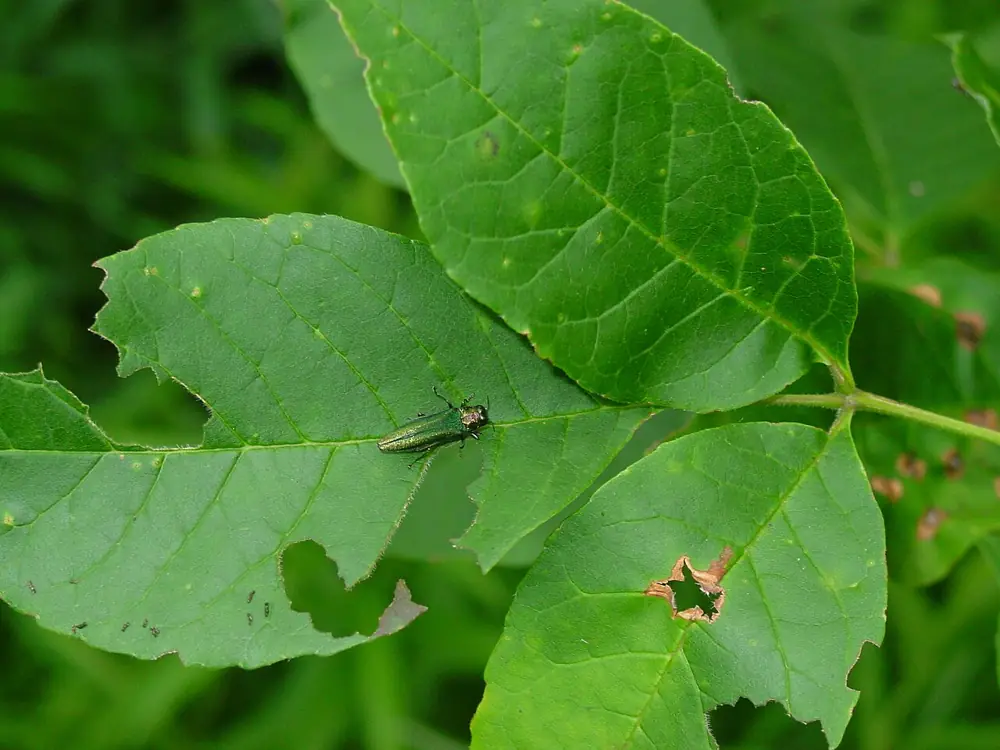

Emerald ash borer (EAB) is a small, metallic green beetle from Asia. It was first identified in North America in 2002 and in western Pennsylvania in 2007, and it is now found in nearly every county in the state (PA DCNR). The larvae feed under the bark and cut off the tree's flow of water and nutrients. An infested ash usually dies three to five years after the attack begins. Every native ash species is vulnerable, and In Lancaster County that includes ash in yards and along streets, and the green ash common on creek banks and floodplains.
Is it an ash tree?
- Branches and buds grow in opposite pairs, directly across from each other. Only a few common trees do this (maples, ash, dogwoods, horse chestnut), so this rules most trees out.
- Leaves are compound: one leaf is made of usually 5 to 9 leaflets along a central stem. Maples have single, lobed leaves; that's the quickest way to tell them apart.
- Bark on mature trees has a tight diamond pattern of interlacing ridges.
Signs of emerald ash borer
DCNR lists these signs; most people notice the first two:
- Thinning and dieback at the top of the crown, while the lower branches still look normal.
- Sprouts along the trunk (epicormic shoots), as the tree tries to replace what it's losing.
- Woodpecker damage: patches where the outer bark has been flaked off, leaving lighter bark underneath.
- D-shaped exit holes about an eighth of an inch across where adults chewed out.
- Vertical bark splits, with S-shaped feeding tunnels visible underneath.
Treat or remove an ash?
DCNR's guidance is direct: "Only ash trees that are healthy and are of value to the homeowner should be considered for treatment," treatment should start before the tree is attacked, and "other ash trees should be removed before they become a hazard."
| The tree | Usually the better choice |
|---|---|
| Healthy, full crown, a tree you'd miss (shade, screening, near the house) | Treat, and keep treating on schedule |
| Starting to thin, but has lost less than about a third of its canopy | Treatment may still work; get it looked at this season |
| Lost more than about 30% of its canopy | Plan removal (Purdue Extension) |
| Dead, or bark falling off in sheets | Remove soon, before it gets brittle |
The treatment options. All of them are systemic insecticides that the tree moves through its tissue:
- Imidacloprid soil drench or injection: sold to homeowners and applied in May or early June (Penn State Extension). It takes a few weeks to move through the tree, and the label sets how big a tree it can protect and how often to reapply.
- Trunk injection with emamectin benzoate: done by a licensed applicator, and protects for two to three years per treatment (multistate EAB insecticide fact sheet). DCNR notes that the most effective option is a product only certified applicators can use, which matters most for large trees.
Treatment doesn't end: a protected ash needs to be treated for as long as you want to keep it. Over a decade or more, that's often still cheaper than removing a large dead tree, which is why treating a healthy, valuable ash can make sense.
Why dead ash shouldn't wait
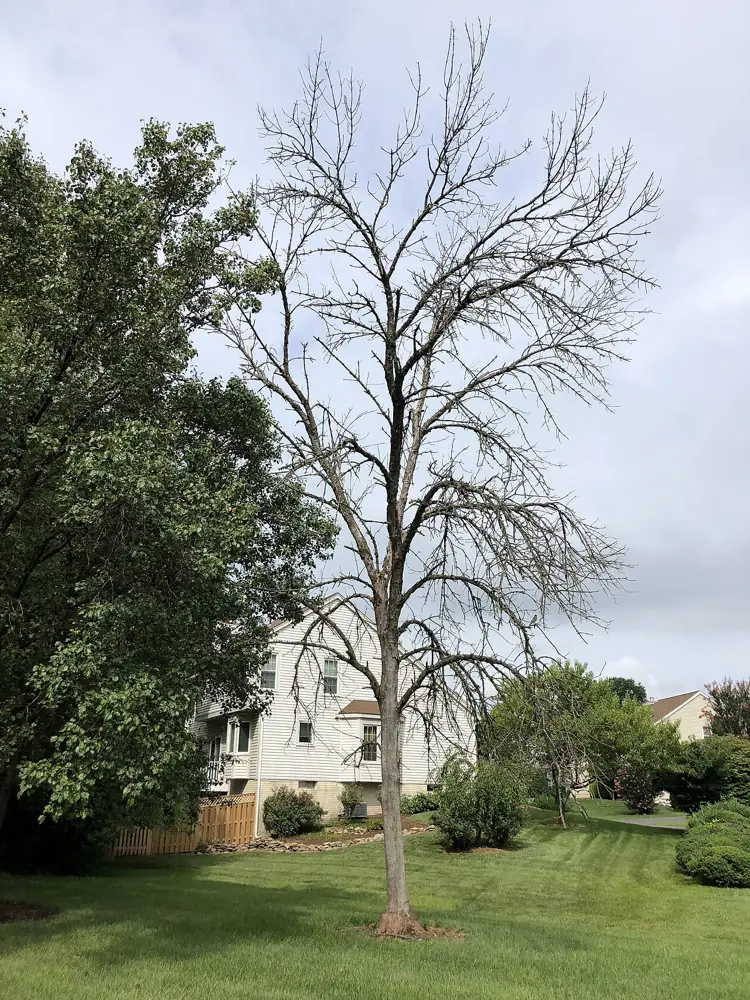

Ash killed by EAB dries out and turns brittle much faster than most dead trees. Purdue Extension warns that EAB-killed ash "become extremely brittle" and that delaying removal makes the job more dangerous. Two practical results:
- It gets harder to take down. Once a dead ash is too brittle to climb safely, crews need a bucket truck, lift or crane, and the job costs more. One utility's EAB plan reports removal costs for dead and dying ash running two to seven times those of live trees (Vermont Electric Co-op).
- Limbs and whole trees fail without warning, often in ordinary wind. If the tree can reach a house, driveway, road or play area, it's the one to deal with first.
Spongy moth
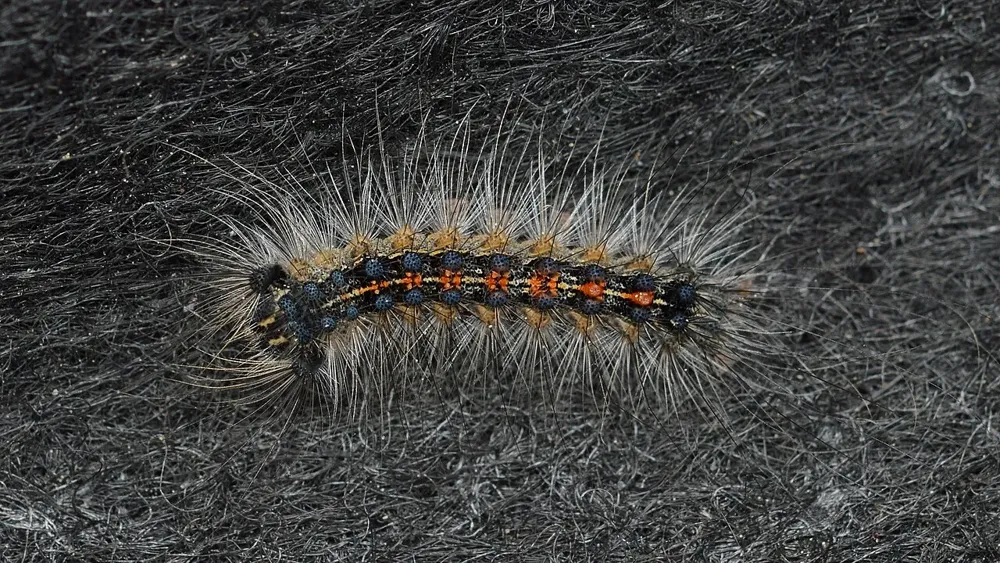

Spongy moth (Lymantria dispar) is the insect formerly called gypsy moth. Its caterpillars eat the leaves of many trees, and oaks are their favorite; they also feed on apple, birch, aspen, willow, basswood, hawthorn, and conifers such as pines, spruces and hemlock (PA DCNR). Pennsylvania's most recent outbreak began in 2021 and stripped hundreds of thousands of acres of forest in the years that followed (WVIA). Populations rise and crash in cycles, so a quiet year can be followed by a bad one.
The caterpillar: hairy, up to about two inches long when grown, with a yellow-and-black head and a distinctive pattern down its back: five pairs of blue spots followed by six pairs of red spots. That pattern separates it from the many look-alike caterpillars. The hairs can irritate skin, so use gloves.
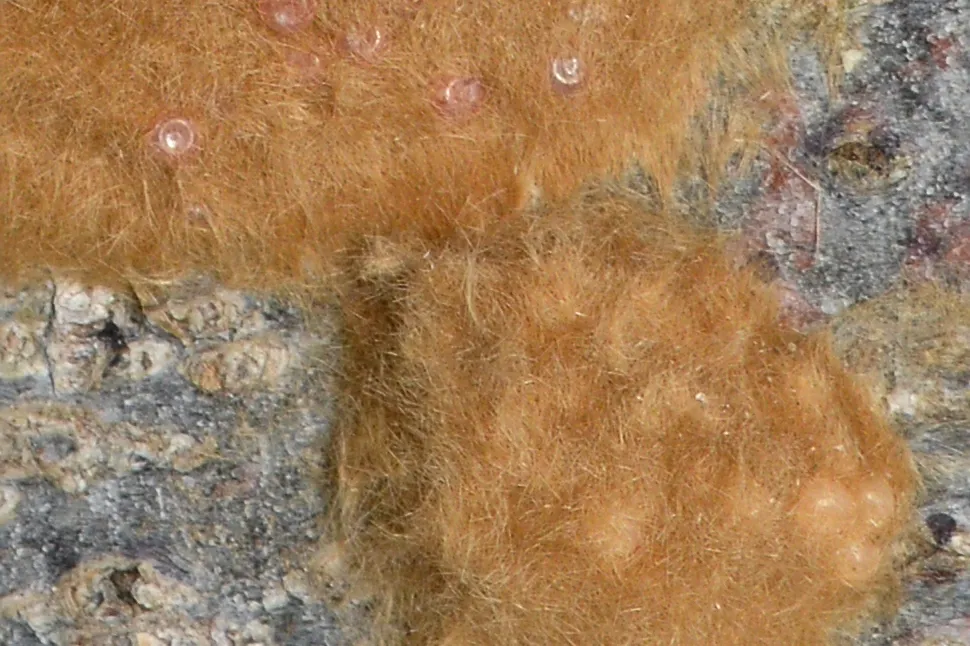

The egg masses: light tan, fuzzy patches laid in summer on trunks, stones, firewood, outdoor furniture and the undersides of ledges. Each holds 100 to 1,500 eggs, which hatch the following spring, from mid-April to early May.
Will a stripped tree die?
Usually not after one year. Healthy hardwoods typically push out a second set of leaves in early summer, and DCNR notes it usually takes more than one year of defoliation to kill a tree. The risk goes up with repeat defoliation and with other stress such as drought or late frost (Penn State Center for Private Forests). Conifers are the exception: a pine, spruce or hemlock can die after a single season of defoliation. If an oak near your house has been stripped two or more years in a row, have it checked the following year; weakened oaks are prone to secondary problems that can leave them dead within a few seasons.
What you can do about spongy moth
DCNR runs aerial spraying on state and federal forest land but does not spray private land. On your own property:
- Scrape off egg masses from late summer through early spring, into a sealed bag or container (or soapy water), and throw them away. Check firewood piles, sheds, swing sets and anything stored outside, and clear away clutter where they hide.
- Burlap bands: in late spring, tie a strip of burlap around the trunk and fold it over. Caterpillars hide under it during the day; scrape them into soapy water every day or two.
- Insecticide only if numbers warrant it. DCNR says insecticides "are not necessary unless the population of spongy moth egg masses or larvae indicate a threat to your trees." When they are needed, timing is usually in May while caterpillars are small, so the decision has to be made the fall or winter before. Some products are sold to homeowners; tall trees need a licensed applicator with the right equipment. Always follow the label.
- Neighborhood or township spraying: private landowners and municipalities can organize their own treatment programs using DCNR's private suppression guidance. If many neighbors have heavy egg masses, that's worth raising with your township.
Firewood: don't move the problem
Both insects travel long distances in firewood: EAB larvae inside the wood, spongy moth eggs on the outside. Pennsylvania restricts bringing firewood in from other states unless it's certified heat-treated, and DCNR asks campers to buy firewood near where they'll burn it (Don't Move Firewood: Pennsylvania). If you're cutting up a dead ash, keep the wood on your property or burn it locally.
Free help in Lancaster County
- Penn State Extension Master Gardeners, Lancaster County: the free Garden Hotline answers home gardeners' questions about tree pests and problems.
- City of Lancaster residents: street trees, and larger private trees, need a free permit from the City Arborist before removal. See the city's trees page or call (717) 291-4846.
- Lancaster County Parks & Recreation keeps a list of state pest and conservation resources on its related links page.
- State guidance: DCNR's emerald ash borer and spongy moth pages, and Penn State Extension.
For spotted lanternfly, tree of heaven and other signs of a declining tree, see our tree health guide.
This guide summarizes published guidance from PA DCNR, Penn State Extension and Purdue Extension; follow the label on any pesticide and check with a certified arborist for a specific tree. Corrections are welcome: use the contact form.