Lancaster County has about 1,400 miles of streams, and the trees along them do more for water quality than almost anything else a landowner can plant. This guide shows how to recognize the native trees you'll find along Lancaster creeks, which ones to plant in a streamside buffer, and where to get trees and help locally.
On this page
Why streamside trees matter
A strip of trees and shrubs along a creek (a riparian buffer) shades the water and keeps it cool, holds the bank together with its roots, filters runoff from lawns and fields, and drops the leaves that feed the insects fish eat. Lancaster's creeks need it: more than half of those 1,400 miles are listed as impaired (Lancaster Clean Water Partners), and the Lancaster County Conservation District's watershed program works on stream restoration and buffer planting across the county, and much of that work comes down to putting the right native trees back along the banks.
The Pennsylvania Fish and Boat Commission's guidelines call a forested buffer the option that "provides the most benefits," recommend it be at least 35 feet wide measured from the top of the bank, and ask that lawns not be mowed right to the water's edge (PA Fish and Boat Commission).
Quick ID table
Flood tolerance is from the Brandywine Conservancy's riparian buffer planting guide, written for southeastern Pennsylvania landowners. "Opposite" means leaves and twigs grow in pairs directly across from each other; most trees are "alternate."
| Tree | Leaves | Best clue | Wet feet |
|---|---|---|---|
| American sycamore | Alternate, big, maple-like | Patchwork bark, white upper limbs | Moderate |
| River birch | Alternate, diamond-shaped, double-toothed | Peeling salmon-to-tan curls of bark | Tolerant |
| Red maple | Opposite, 3 lobes, toothed | Red twigs, buds and early spring flowers | Tolerant |
| Silver maple | Opposite, 5 deep lobes | Silvery-white leaf undersides | Tolerant |
| Boxelder | Opposite, compound (3 to 5 leaflets) | Green twigs, often with a whitish bloom | Very tolerant |
| Black willow | Alternate, long and narrow | Leaning, often multi-trunked, at the water's edge | Very tolerant |
| Swamp white oak | Alternate, wavy edges, wider near the tip | Two-tone leaves: dark green above, whitish below | Tolerant |
| Pin oak | Alternate, deep lobes with bristle tips | Lower branches angle downward | Tolerant |
| Black gum | Alternate, glossy, smooth-edged | Early, brilliant red fall color; blocky bark | Moderate |
| American hornbeam | Alternate, double-toothed | Smooth gray trunk with sinewy, muscle-like ridges | Tolerant |
The trees, one by one
American sycamore (Platanus occidentalis)
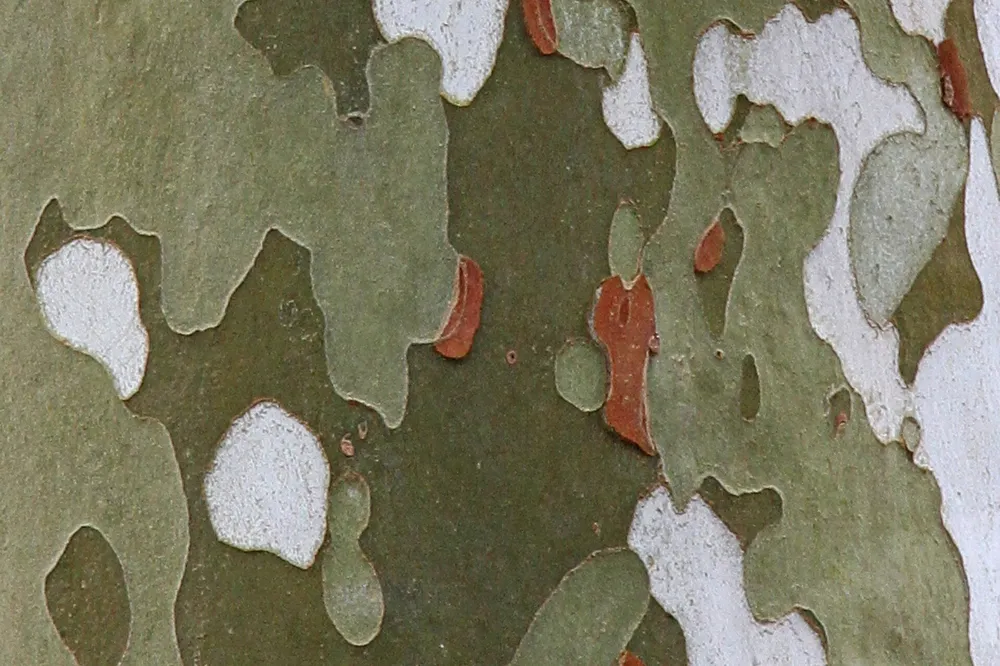

The easiest streamside tree to spot, even from a car. The bark flakes off in patches, leaving a camouflage pattern of olive, tan and cream, and the upper limbs turn almost white. Leaves are large (often wider than your hand) with three to five shallow lobes, so people mistake sycamore for a maple, but sycamore leaves are alternate, not paired. Round, inch-wide seed balls hang on long stalks through the winter. Sycamores grow into some of the biggest trees along Lancaster's larger creeks.
River birch (Betula nigra)
Look for bark that peels in thin, papery curls in shades of salmon, cinnamon and tan, especially on younger trunks and branches; old trunks turn darker and scaly at the base. Leaves are roughly diamond-shaped with a wedge-shaped base and double-toothed edges. Often grows with several trunks. Its roots hold streambanks well, which is why it's a buffer favorite.
Red maple (Acer rubrum)
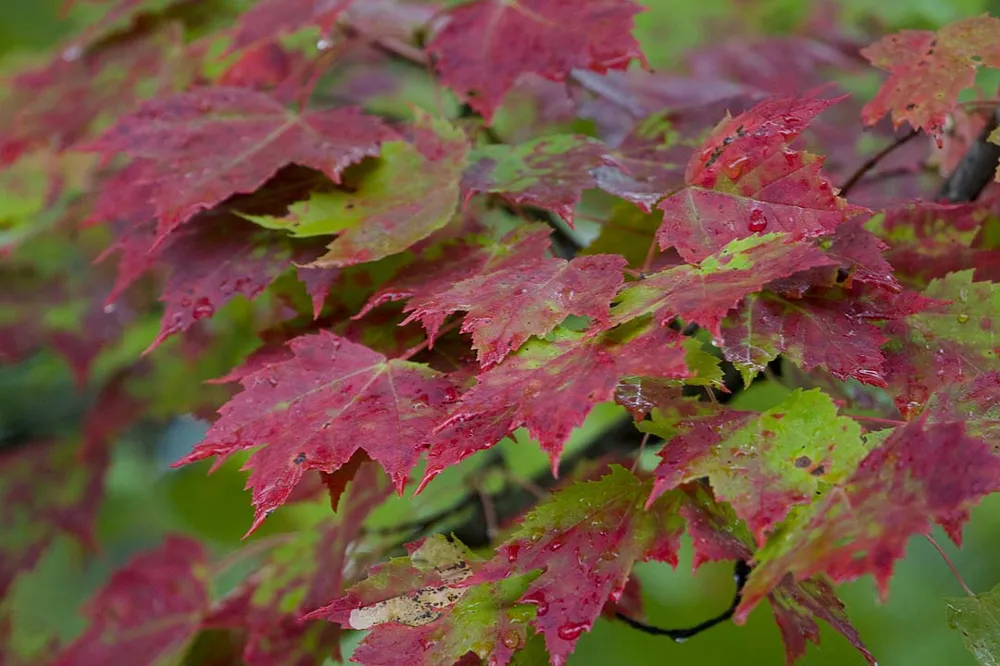

Red shows up in every season: red buds and twigs in winter, tiny red flowers on bare branches in late winter or early spring (one of the first trees to bloom), red seeds in spring, red leaf stems in summer and red to orange fall color. Leaves are opposite with three main lobes, toothed edges and sharp V-shaped notches between the lobes. Young bark is smooth and light gray. Red maple grows almost anywhere, wet or dry.
Silver maple (Acer saccharinum)
Leaves are opposite, with five lobes cut deeply toward the center, and the undersides are silvery-white, so a breeze makes the whole tree flash. Old trunks have shaggy bark that peels in long strips. Silver maple grows fast on floodplains and gets very large, but its wood is weak (see big streamside trees below).
Boxelder (Acer negundo)
A maple that doesn't look like one: its leaves are compound, with usually three to five leaflets, the end one often lobed, which gets it confused with ash and even poison ivy. Two clues: the twigs are green, often with a whitish waxy coating, and it makes paired, winged maple seeds. Poison ivy is a vine or low shrub with leaflets in threes that alternate along the stem; boxelder's leaves are opposite. Boxelder is short-lived and weak-wooded, but it tolerates flooding better than almost any tree.
Black willow (Salix nigra)
The tree right at the water's edge, often leaning out over the creek with several trunks. Leaves are long (3 to 6 inches), narrow and finely toothed; the bark is dark and deeply furrowed. Black willow tolerates flooding better than nearly anything, but it's short-lived and drops branches regularly.
Swamp white oak (Quercus bicolor)
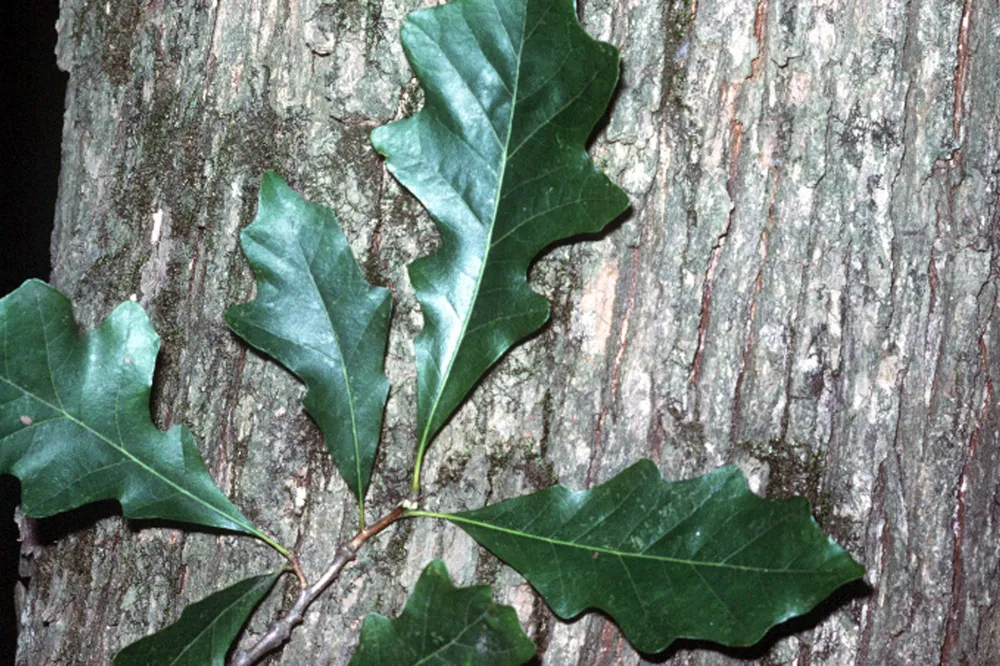

The name bicolor is the clue: leaves are dark, shiny green on top and pale, whitish and slightly fuzzy underneath. They're wider toward the tip than the base, with wavy or shallowly lobed edges rather than deep lobes. Acorns hang on unusually long stalks, and bark on the upper branches peels in ragged flakes. A long-lived oak that handles wet ground; its acorns feed a long list of wildlife.
Pin oak (Quercus palustris)
Leaves have deep, rounded notches and lobes ending in bristle tips. The giveaway is the shape: lower branches angle downward, middle ones stick straight out and upper ones point up. Pin oaks often hold dried brown leaves into winter. Common on wet, flat ground and one of the trees given out at Lancaster Water Week.
Black gum (Nyssa sylvatica)
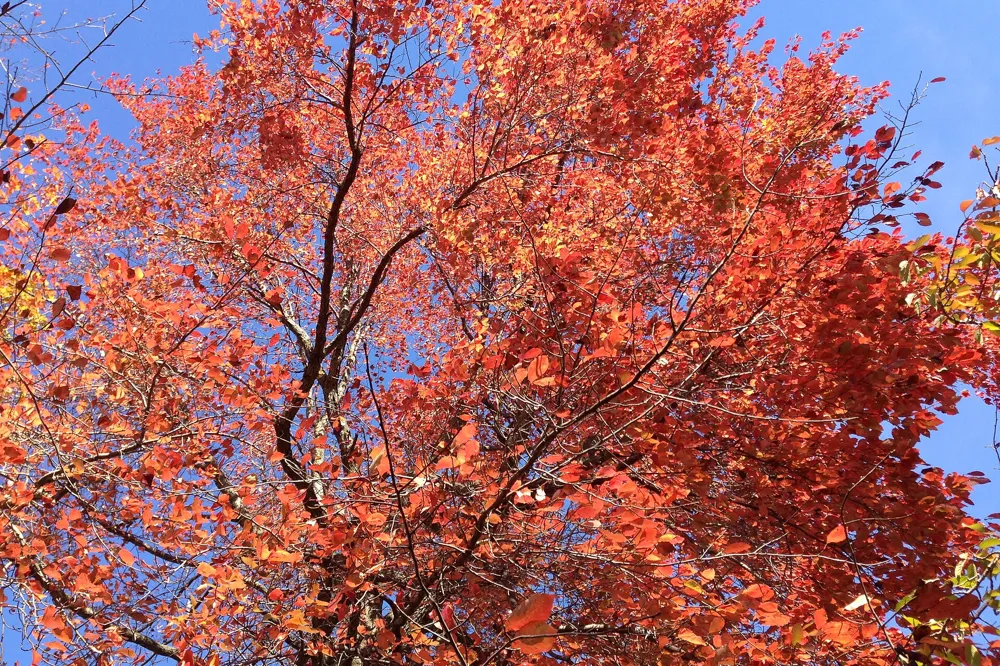

Also called black tupelo. Leaves are glossy, oval and smooth-edged, often bunched toward the twig tips, and they're among the first to turn in fall, going a brilliant scarlet. Mature bark breaks into thick blocks like alligator hide. Small dark blue fruits are a favorite of migrating birds.
American hornbeam (Carpinus caroliniana)
A small understory tree, also called musclewood or ironwood: the smooth, blue-gray trunk has twisting ridges that look like flexed muscle. Leaves are small, alternate and double-toothed. It grows in the shade of bigger trees along creeks.
Green ash: recognize it, but don't plant it
Green ash (opposite, compound leaves with 5 to 9 leaflets) was once one of the most common floodplain trees in the county. Emerald ash borer is killing most of them, so it's not recommended for planting now, and dead streamside ash are a growing hazard. See our emerald ash borer guide.
Native shrubs for the bank
Shrubs fill in under young trees and grab the bank fast. Natives that do well in wet Lancaster County soils include:
- Silky dogwood: 6 to 10 feet, blue berries in late summer; handles shade and wet ground.
- Spicebush: small yellow flowers in early spring; scratch a twig and it smells spicy.
- Winterberry: a native holly that drops its leaves, leaving bright red berries on bare branches all winter.
- Arrowwood viburnum: white flower clusters in late spring and blue-black berries birds strip in fall.
- Red chokeberry: white spring flowers and red fall fruit and color.
Deer browse young shrubs hard; the Brandywine guide suggests 4 to 5 foot mesh cages around each plant.
Invasive look-alikes and problem plants
Streambanks are where invasive plants spread fastest, because floods carry their seeds and root pieces downstream. The ones to know along Lancaster creeks:
- Japanese knotweed: dense stands of hollow, bamboo-like stems 6 to 10 feet tall. It shades out everything else and leaves banks bare and eroding in winter.
- Multiflora rose: arching, thorny canes with clusters of small white flowers.
- Oriental bittersweet and Japanese hops: vines that climb and smother young trees.
- Common reed (Phragmites): tall grass with feathery plumes in wet spots.
- Tree of heaven: compound leaves like a giant sumac and a rank smell when crushed; the favorite host of spotted lanternfly (more in tree health).
Near water, the Fish and Boat Commission asks that invasives be removed by hand or machine when possible, and that any herbicide be one labeled for use near water. For help identifying a plant, the Pennsylvania Native Plant Society's ID resources are a good start.
Planting a buffer that survives
- Check your drainage. Dig a hole about a foot on each side, fill it with water, let it drain, then fill it again. If the second fill takes more than 24 hours to drain, choose flood-tolerant trees (Brandywine Conservancy).
- Put the wettest-tolerant trees closest to the water. Red maple, river birch, sycamore, boxelder and black willow belong nearest the bank; oaks and black gum a bit farther back.
- Plant small. Seedlings and small bare-root trees establish faster and cost far less than big nursery trees.
- Protect every tree. Deer and voles kill more buffer trees than anything else. Tree shelters (tubes or 5-foot mesh) raised average survival by about 39% in one long-term study cited by the Brandywine guide. Remove them once the trunk is 1.5 to 2.5 inches thick at the top of the shelter, usually years 3 to 5.
- Plan on five years of care. Keep weeds and vines off the young trees, check shelters after floods, and replace trees that die. After about five years the trees usually shade out most of the competition.
When a big streamside tree is a problem
The trees that love wet ground (silver maple, black willow, boxelder) are also the weakest-wooded, and creek banks undercut by floods can leave big trees leaning toward a house, shed or road. A few things worth knowing:
- Keep the roots in the bank. If a streamside tree has to come down, leaving the stump and roots in place helps hold the soil; grinding or pulling a stump on an eroding bank can make the erosion worse.
- Leave fallen wood in the creek unless it's causing damage or a safety problem. The Fish and Boat Commission notes that large woody debris is fish habitat.
- Work in the stream itself can need a permit. Using equipment in the channel or reshaping a bank can fall under Pennsylvania's waterway rules; the Lancaster County Conservation District is the place to ask first.
- Dead ash along creeks become brittle quickly and are best dealt with before they fall (why dead ash shouldn't wait).
Free trees and help in Lancaster County
- Lancaster Water Week: the Lancaster Conservancy gives away free native trees and shrubs at Water Week events (details).
- Conservation District tree seedling sale: the Lancaster County Conservation District holds an annual spring sale of native seedlings, with orders taken in late winter.
- Buffer and stream help: Lancaster County Watersheds (the Conservation District's watershed department) and Lancaster Clean Water Partners work with landowners on buffers and stream projects.
- Choosing species: the Chesapeake Conservancy's free Pennsylvania Native Tree Selector, and Penn State Extension's guide to riparian buffers.
This guide draws on the PA Fish and Boat Commission's riparian buffer guidelines, the Brandywine Conservancy's buffer planting guide, Penn State Extension and the Lancaster County Conservation District. Corrections are welcome: use the contact form.